
The Hidden Cost of the Traditional Inspection Workflow
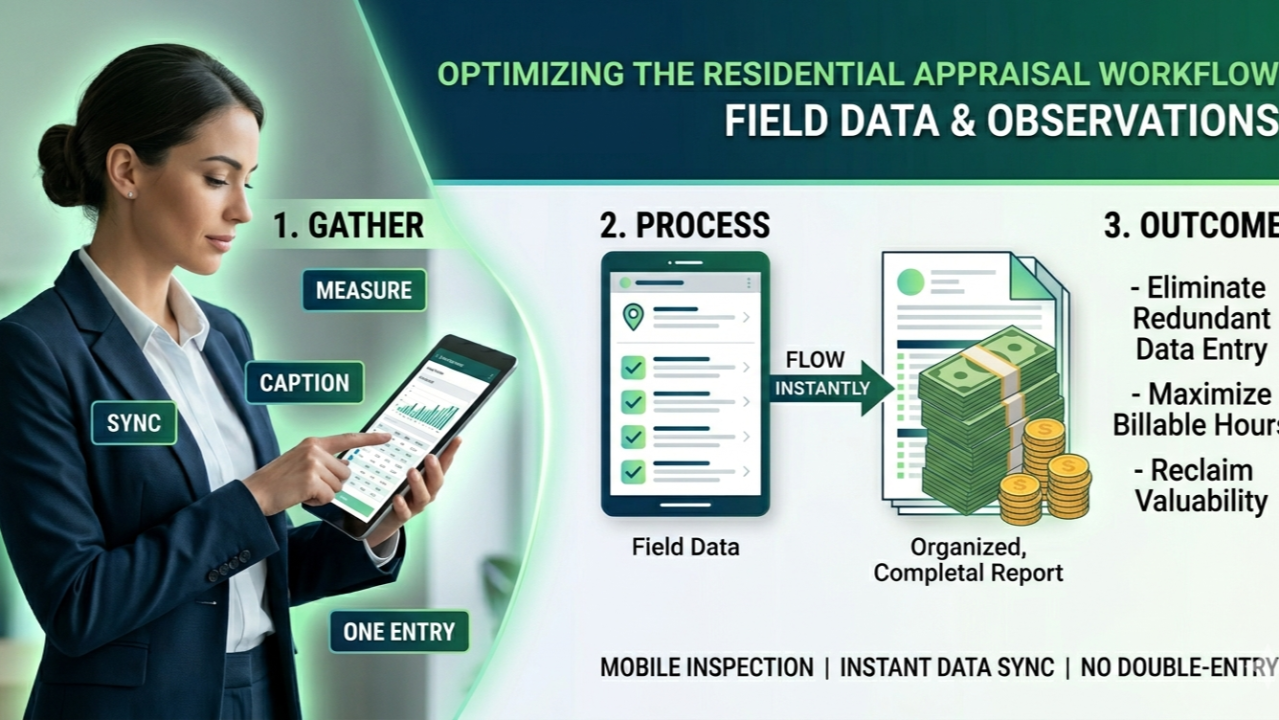
Why are appraisers still doing the same work multiple times? Not because they want to, and not because it creates better valuation reports — simply because that's how the process has always worked. An appraiser arrives at a property, takes photos, scribbles notes, measures rooms, records observations, then drives back to the office to upload photos, organize files, redraw sketches, re-enter notes, and finally start building the report. Step back, and the inefficiency is obvious: the inspection isn't the beginning of the appraisal report, it's just the beginning of a second round of data entry.
The three-time problem
Consider one observation: "the kitchen was renovated approximately five years ago with updated cabinets, countertops, and appliances." In a traditional workflow that single data point gets touched three separate times — observed during the inspection, written into field notes, then typed again into the appraisal software — before it ever reaches the client. Multiply that across an entire assignment: property characteristics, room measurements and floor plans, photos, condition observations. The industry has accepted this duplication as status quo, but normal doesn't mean efficient.
What that costs over a year
The math makes the cost concrete. A typical appraiser completing 250 reports a year, spending just 45 minutes per report re-entering notes and rebuilding sketches, loses 187.5 hours annually — nearly five full workweeks just moving information from one place to another. Valued at a conservative $400/hour opportunity cost for licensed valuation, litigation, or consulting work, that's roughly $75,000 a year (even at a baseline $150/hour billable rate, it's still close to $30,000 of pure administrative waste) — and none of it comes from valuation complexity or professional judgment, only from information being processed a second time at a desk.
Appraisers are paid for judgment, not data entry
Appraisers aren't paid to be typists — they're paid for judgment: analyzing volatile markets, understanding systemic risk, determining credible value. Property insurance adjusters, field inspectors, construction managers, and logistics companies all moved to mobile years ago, because information is most valuable at the exact moment it's captured. The future inspection looks frictionless: photos auto-categorized and tagged, measurements captured digitally into a real-time floor plan, characteristics structured as they're observed, voice dictation becoming instant commentary — so that by the time an appraiser backs out of the driveway, the report's foundation already exists. Mobile isn't just a clipboard replacement; it's about eliminating redundant labor and giving appraisers their time back for the one thing technology can't replicate — professional human judgment. As UAD 3.6 pushes the industry toward deeply structured data, the firms that thrive will be the ones that eliminate this workflow bottleneck before they even leave the property.